Launch offer — valid today only

📄 Digital book in PDF · read it on your phone or print it

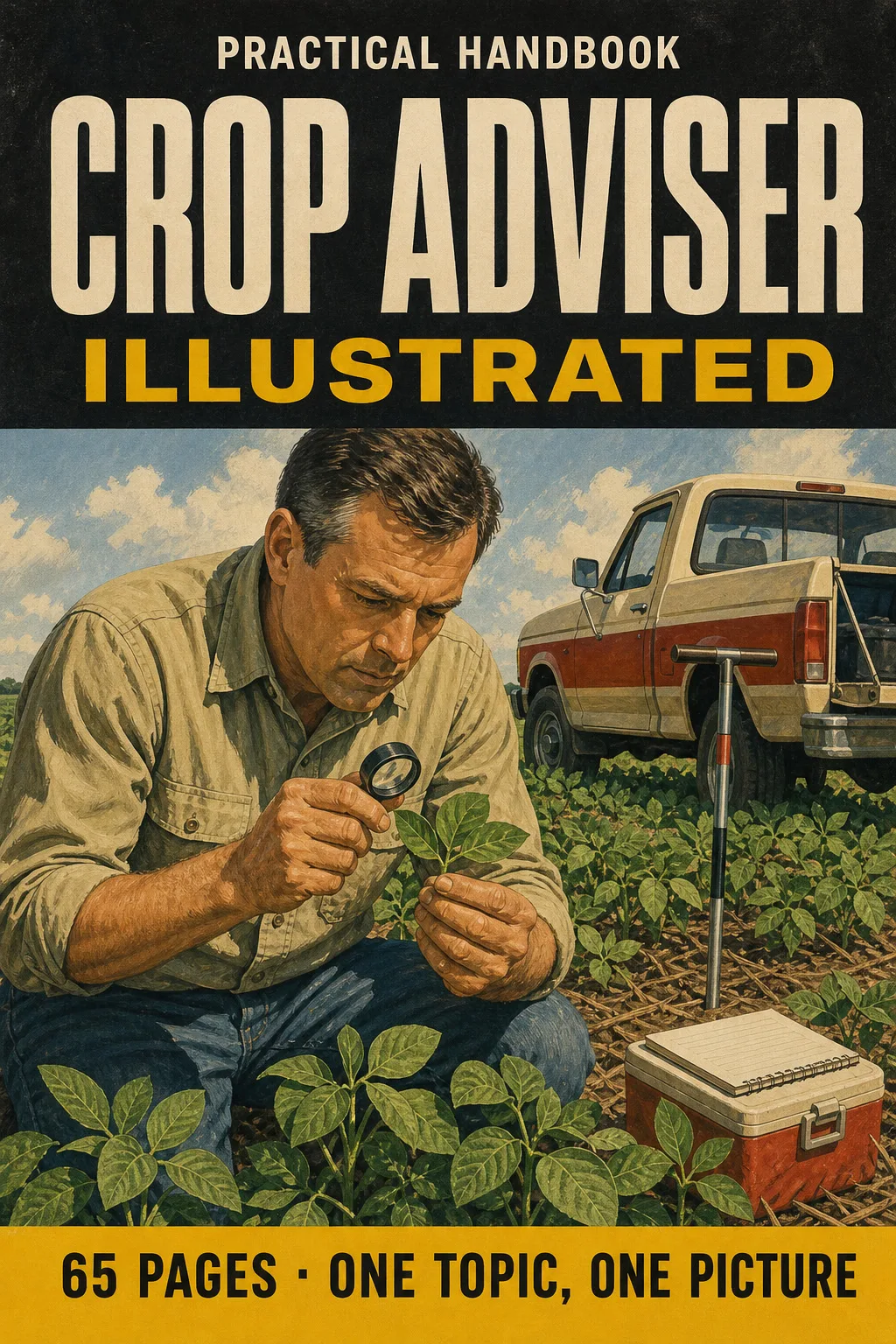
Agronomy for the Crop Adviser Exams, Illustrated One Topic on Every Page

Soil texture, CEC, the 4Rs, deficiency symptoms, IPM, herbicide site-of-action groups, corn and soybean stages, lime and sprayer math. Every topic gets its own page: the drawing first, then what you need to remember. 65 illustrated pages.

START STUDYING THIS WAY

🔒 Secure checkout · PDF by email · 30-day guarantee

Every topic, its own pageEach concept drawn, with the explanation right beside it
65 illustrated pages7 parts, from how the exams work to exam-week review
Up-to-date sourcesICCA performance objectives, land-grant extension and NRCS Standard 590
PDF by emailFormat

Look Inside the Book

Every page has one big drawing and a box with the numbers, steps and rules you need to know:

International + local board exam: 4 sections each, online, pass/fail, results valid 5 years.
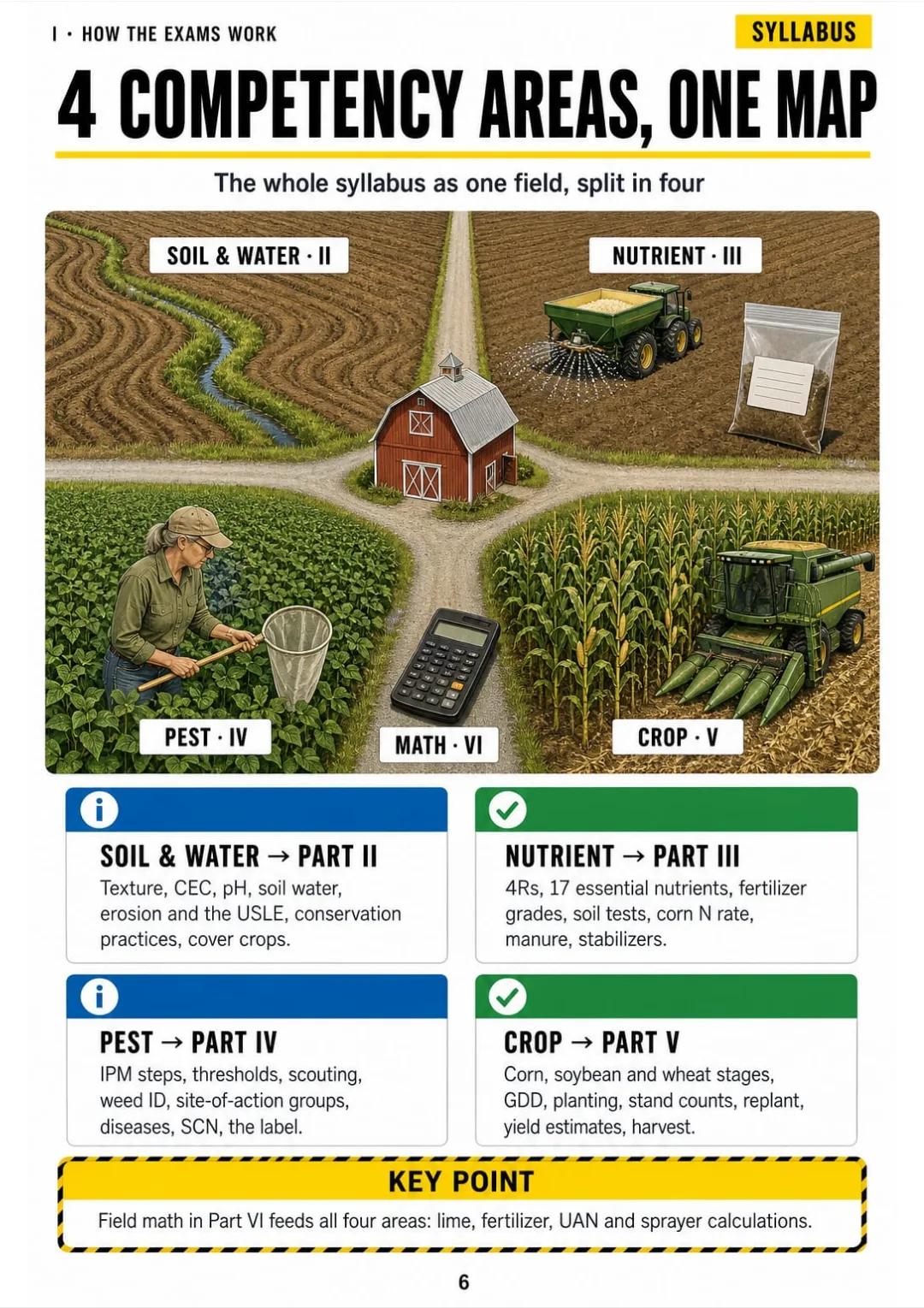
Soil & Water, Nutrient, Pest and Crop Management: each area mapped to its part of the book.
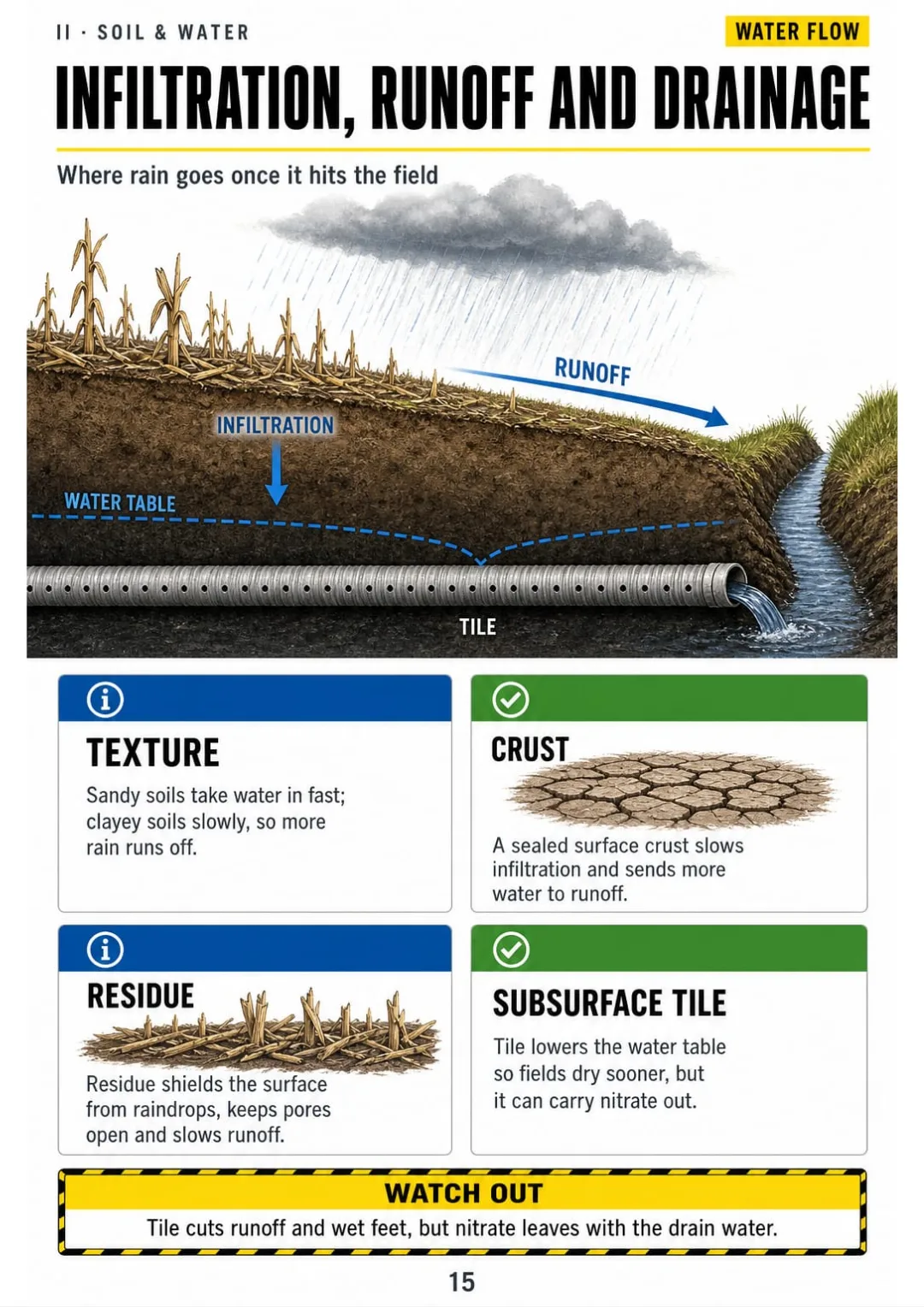
Infiltration, runoff and tile: how texture, crust and residue change the split
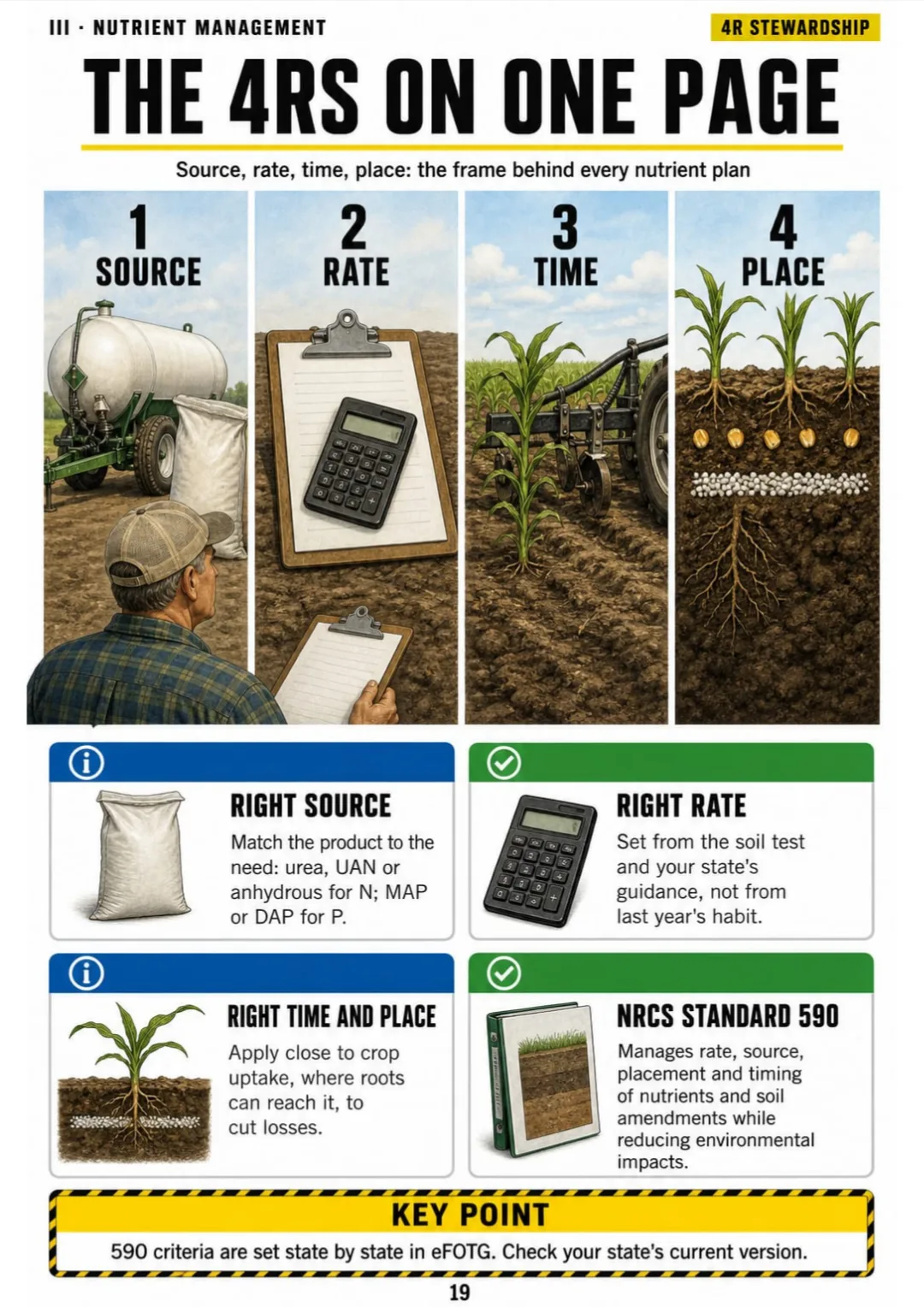
Right source, rate, time and place, plus how NRCS 590 builds a plan around them
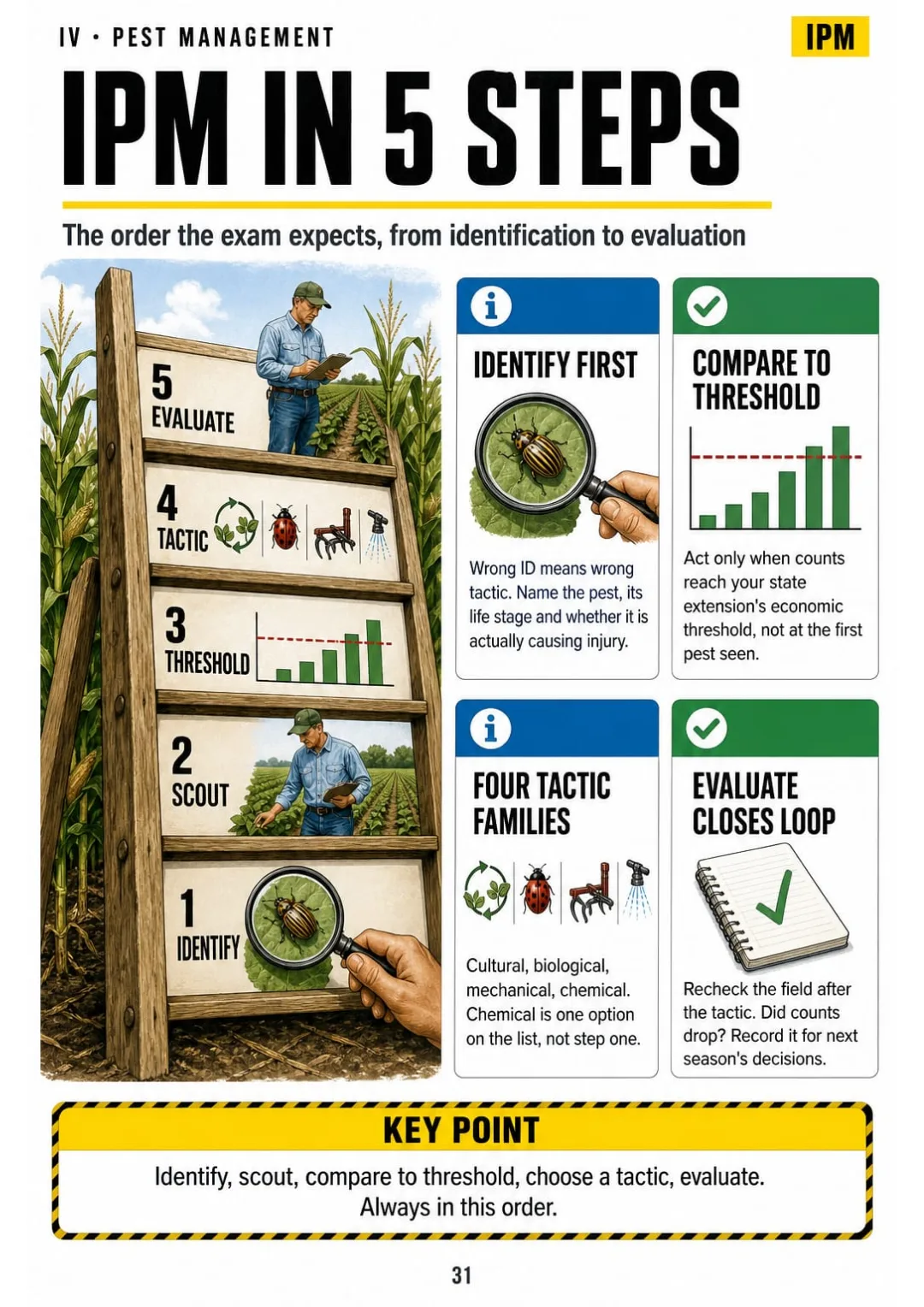
Identify → scout → threshold → tactic → evaluate: the IPM ladder in one drawing.
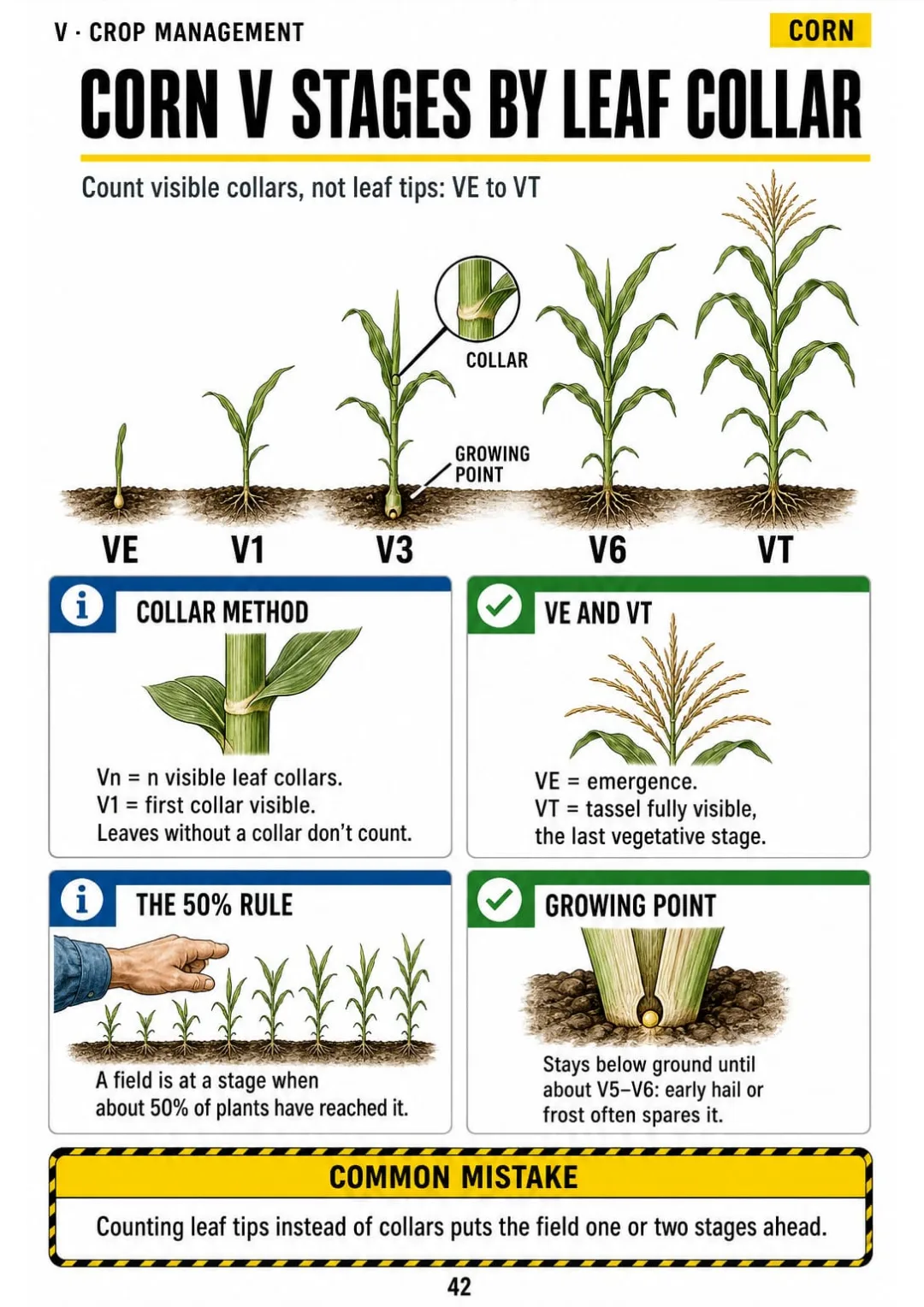
Corn V stages: count visible leaf collars from VE to VT, 50% of plants
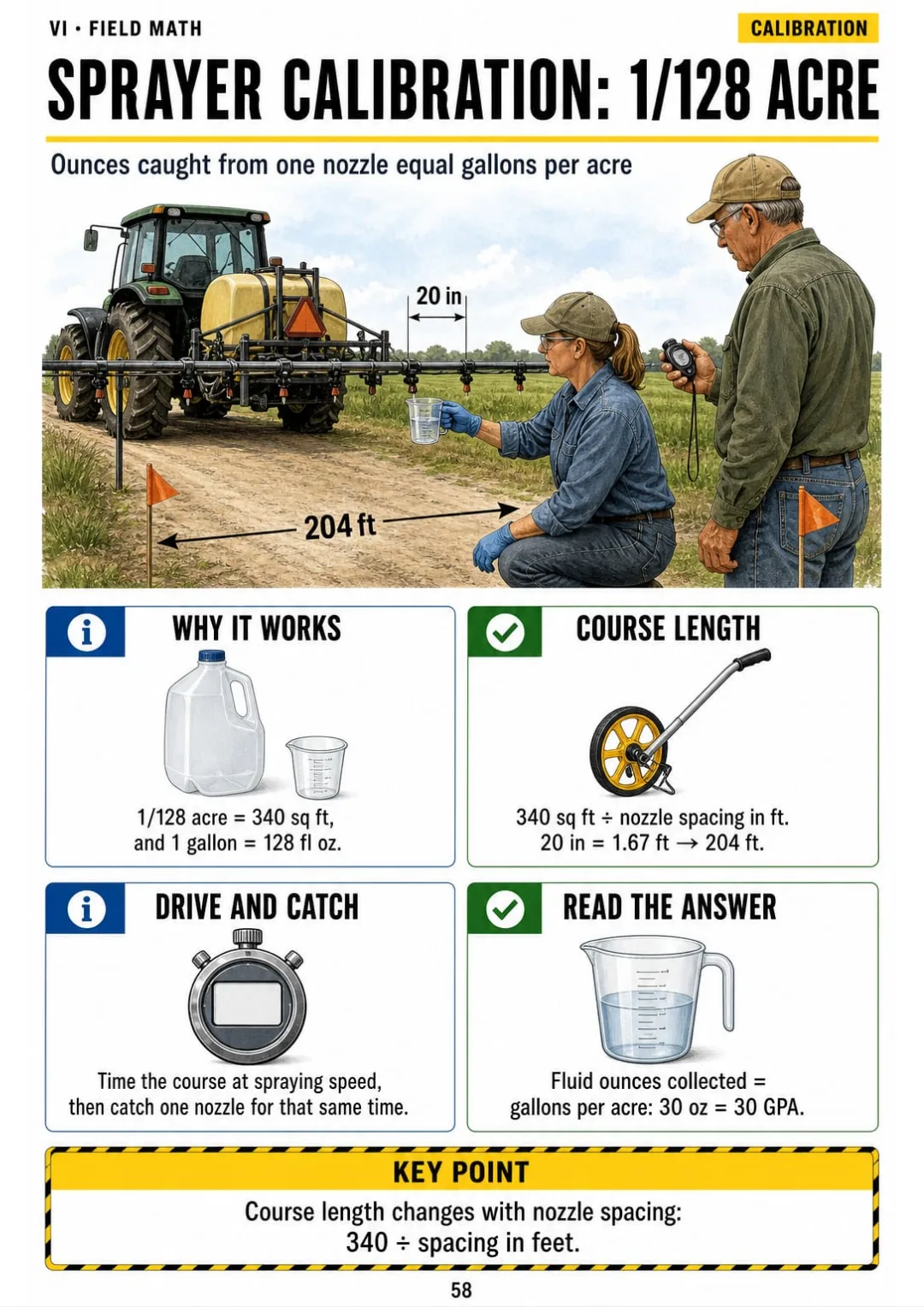
20-in spacing → 204-ft course · ounces caught = GPA
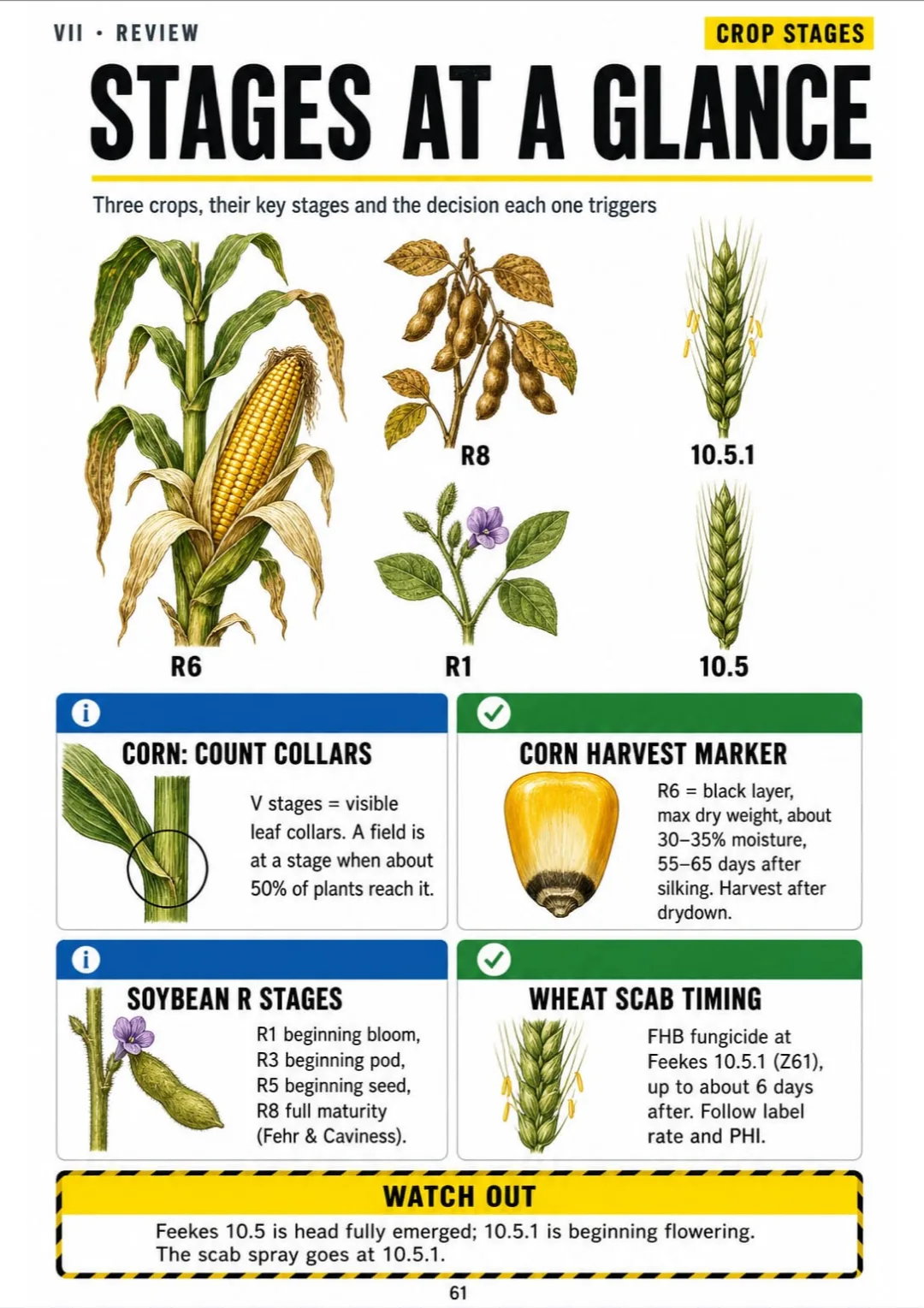
Corn R6 black layer, soybean R8, wheat Feekes 10.5.1 for scab: one printable page.

Swipe to see more →

These are real pages from the book. The table of contents is the full one: 7 parts and 61 topics.

The Problem Isn't You. It's How It Was Explained to You.

You're on a practice question: the soil test calls for 2 tons of lime per acre at 100% ECCE, and your ag lime is 60%. You've spread lime for twenty years, and the number still won't click.

The study guide gives you the formula in one line, between two others. Nothing on the page shows you why you divide and not multiply.

Infiltration, runoff and tile: how texture, crust and residue change the split

In this book, that same question is one page: the recommendation on top, the ECCE as a fraction, one arrow down. 2 ÷ 0.60 = 3.3 tons per acre, the same steps every time.

Other topics work the same way: CEC, the 4Rs, the IPM ladder, corn V stages by leaf collar, the units card for field math. Each one gets its own page.

Next time a lime question comes up, you run the same steps and answer it, no manual needed.

COMPARE FOR YOURSELF

The Same Topic, Two Ways to Study It

THIS
  • The manual: line after line
  • Mobile and immobile nutrients in one long paragraph
  • Pale corn, and you still can't tell N from S
Nutrient mobility within the plant determines where deficiency symptoms first appear: mobile nutrients, including nitrogen, phosphorus, potassium and magnesium, are translocated from older tissue to areas of new growth when supply is insufficient, so symptoms typically develop on the lower, older leaves, whereas immobile nutrients, including calcium, sulfur, boron, iron, manganese, zinc and copper, cannot be readily remobilized, and symptoms therefore develop first on the upper, younger leaves, a distinction that is essential when differentiating, for example, nitrogen from sulfur deficiency in corn.
FOR THIS
  • One plant drawn: lower leaves vs. new growth
  • Lower leaves pale: N. New leaves pale: S
  • You see it and you get it
Soil & Water, Nutrient, Pest and Crop Management: each area mapped to its part of the book.
CONTENTS

Take a Look at the 7 Parts and 61 Topics

How the exams work, soil and water, nutrient management, IPM, crop management, field math and exam-week review: 65 pages, all illustrated

IHow the Exams Work · pp. 5-8
  1. Two exams: International and local board
  2. The 4 competency areas on one map
  3. How to read a performance objective
  4. How to use this book between harvest and planting
IISoil & Water Management · pp. 9-18
  1. Soil texture in the triangle
  2. Soil structure and compaction
  3. The soil profile: O, A, E, B, C, R
  4. CEC: the soil's parking lot
  5. Soil pH and nutrient availability
  6. Water in the soil: field capacity to wilting point
  7. Infiltration, runoff and drainage
  8. Erosion and the USLE
  9. Conservation practices that hold soil
  10. Cover crops: what each one does
IIINutrient Management · pp. 19-30
  1. The 4Rs on one page
  2. The 17 essential nutrients
  3. Mobile or immobile: where symptoms show up
  4. Deficiency symptoms drawn on the leaf
  5. The nitrogen cycle and where N is lost
  6. Phosphorus and potassium in the soil
  7. Fertilizer grades: what 18-46-0 means
  8. Taking a good soil sample
  9. Reading a soil test report
  10. Corn N rate: MRTN and credits
  11. Manure as a nutrient source
  12. Nitrogen timing and stabilizers
IVIntegrated Pest Management · pp. 31-41
  1. IPM in 5 steps
  2. Economic injury level versus economic threshold
  3. Scouting patterns in the field
  4. Insect life cycles
  5. Weed ID: grass, broadleaf, sedge
  6. Herbicide site-of-action groups
  7. Herbicide resistance management
  8. The disease triangle and key diseases
  9. Soybean cyst nematode
  10. Fungicide and insecticide groups
  11. The label is the law: safe application
VCrop Management · pp. 42-52
  1. Corn vegetative stages by leaf collar
  2. Corn reproductive stages R1 to R6
  3. Soybean stages: V and R
  4. Wheat stages: Feekes and Zadoks
  5. Growing degree days
  6. Hybrid and variety selection
  7. Planting date, depth and population
  8. Stand counts in 1/1,000 acre
  9. Replant decisions after hail or frost
  10. Estimating corn yield before harvest
  11. Harvest, moisture and bushel weights
VIField Math Step by Step · pp. 53-60
  1. The units you need on one card
  2. Lime rate adjusted for ECCE
  3. Pounds of product for a nutrient rate
  4. Liquid N: UAN in gallons per acre
  5. Building a blend for N, P and K
  6. Sprayer calibration: the 1/128 acre method
  7. Sprayer formulas: GPM and GPA
  8. How much product goes in the tank
VIIReview and Exam Week · pp. 61-65
  1. Stages at a glance: corn, soybean, wheat
  2. Site-of-action groups at a glance
  3. Formulas at a glance
  4. Frequent mistakes on calculation questions
  5. Exam-day checklist

One Page, One Topic, All Clear

Think of it this way:

A grower calls from the field: his corn looks pale and he wants to know if it's nitrogen or sulfur. Or the exam asks the same thing in textbook words. You need to know where on the plant to look.

In the book you open the page on mobile and immobile nutrients and see the plant drawn: mobile nutrients show up on the lower leaves, immobile ones on the new growth.

Identify → scout → threshold → tactic → evaluate: the IPM ladder in one drawing.

Same with soil texture, the 4Rs, the IPM ladder, corn V stages and sprayer calibration: each one on its own page.

Crop Adviser Illustrated is 7 parts and 61 topics, all drawn, with stages, site-of-action groups and formulas at a glance at the end.

What you see drawn, you don't have to memorize.

What's Inside Crop Adviser Illustrated:

Ipp. 5-8

How the Exams Work

The International and local board exams, the 4 competency areas on one map, how to read a performance objective and how to fit study between harvest and planting.

IIpp. 9-18

Soil & Water Management

Soil texture in the triangle, structure and compaction, the soil profile, CEC, pH, soil water, infiltration and drainage, erosion and the USLE, conservation practices and cover crops.

IIIpp. 19-30

Nutrient Management

The 4Rs, the 17 essential nutrients, mobile vs. immobile, deficiency symptoms on the leaf, the N cycle, P and K, fertilizer grades, soil sampling and test reports, MRTN, manure and N timing.

IVpp. 31-41

Integrated Pest Management

IPM in 5 steps, EIL vs. economic threshold, scouting patterns, insect life cycles, weed ID, herbicide groups and resistance, the disease triangle, SCN, fungicide and insecticide groups and the label.

Vpp. 42-52

Crop Management

Corn V and R stages, soybean stages, Feekes and Zadoks, growing degree days, hybrid selection, planting, stand counts, replant decisions, yield estimates and bushel weights.

VIpp. 53-60

Field Math Step by Step

The units card, lime rate adjusted for ECCE, pounds of product per nutrient rate, UAN in gal/acre, N-P-K blends, sprayer calibration by the 1/128 acre method, GPM and GPA, and tank mixes.

VIIpp. 61-65

Review and Exam Week

Stages, site-of-action groups and formulas at a glance, frequent mistakes on calculation questions and an exam-day checklist.

At the end of the book: Stages, site-of-action groups and formulas at a glance, plus an exam-day checklist.
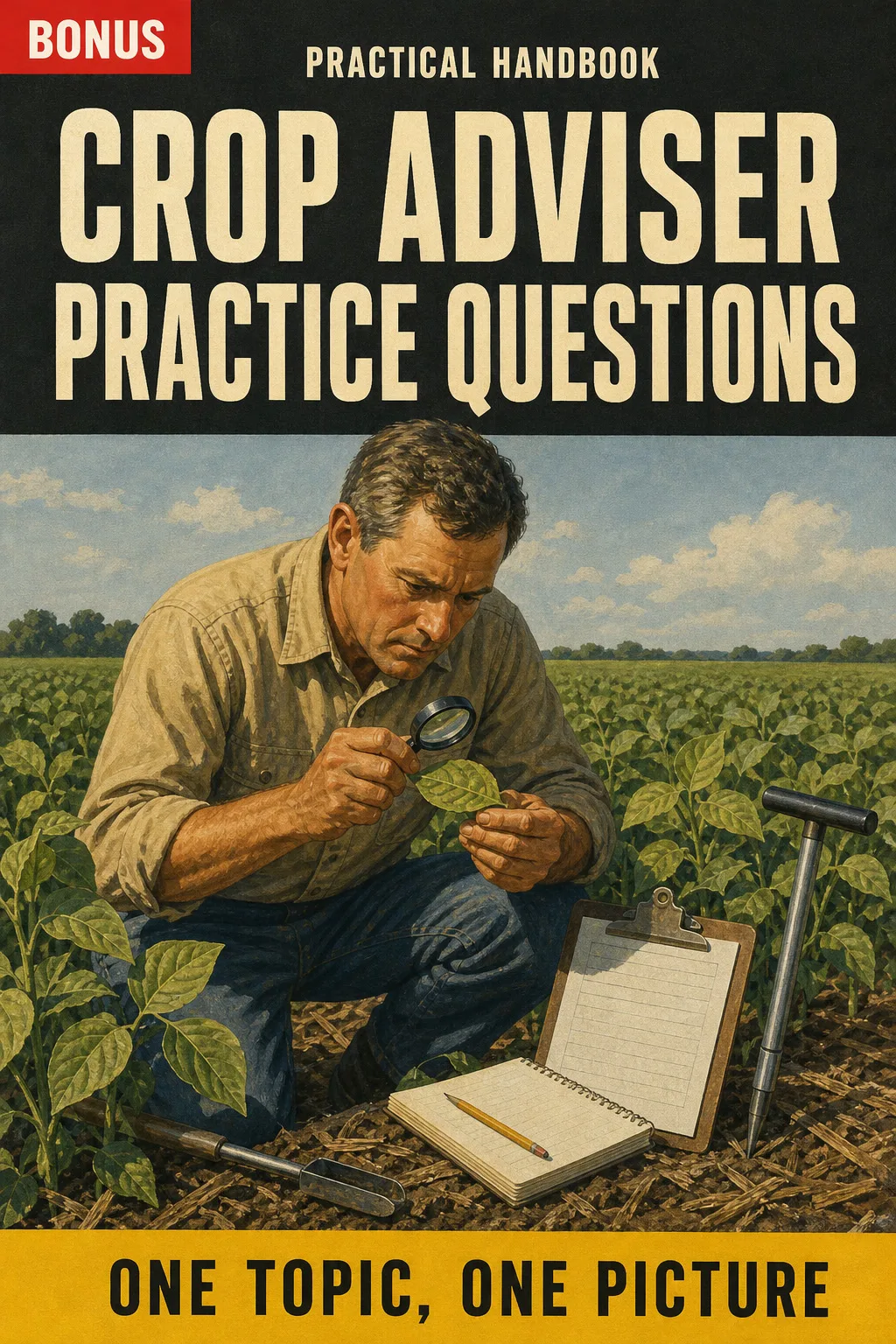
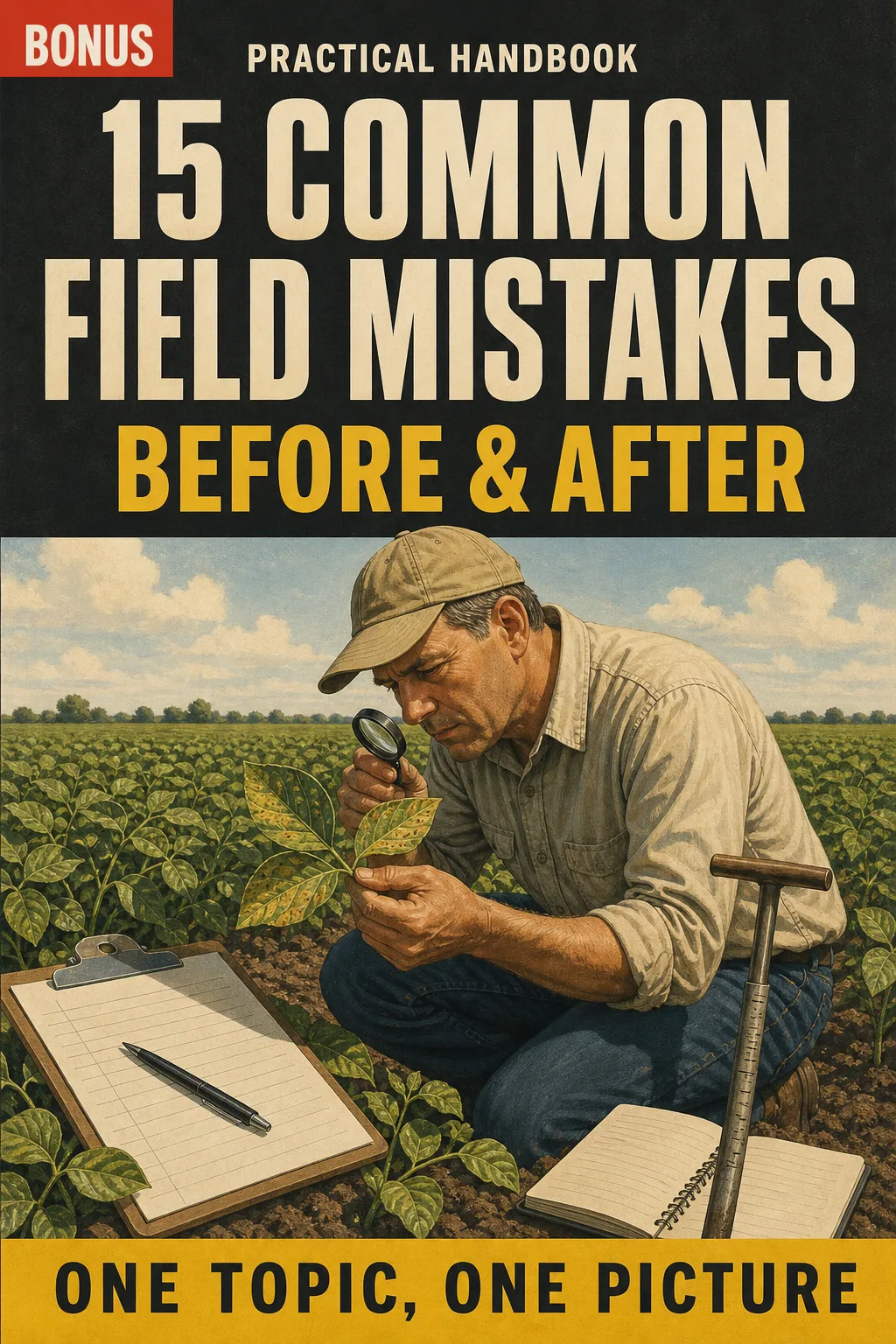
Plus: 2 Free Books

Crop Adviser Practice Questions

BONUS 1: «Crop Adviser Practice Questions»

Value on its own: US$ 17.90

Exam-style questions for all 4 areas, each answer explained with the page to go back to, so you find your weak spots before exam day.

15 Common Field Mistakes: Before & After

BONUS 2: «15 Common Field Mistakes: Before & After»

Value on its own: US$ 14.90

The most common agronomy mistakes, from lime rates to sprayer calibration, each one drawn wrong and then right, so you can review them at a glance.

Crop Adviser Illustrated with 2 Free Books

  • Crop Adviser Illustrated: 65 illustrated pagesUS$ 63
  • BONUS 1: Crop Adviser Practice QuestionsUS$ 17.90
  • BONUS 2: 15 Common Field Mistakes: Before & AfterUS$ 14.90
  • High-resolution PDF to printIncluded
Total value US$ 95.80
YOUR PRICE:
US$ 27
You save US$ 68.80
YES, I WANT CROP ADVISER ILLUSTRATED FOR US$ 27

📄 This is a digital PDF book sent to your email: nothing is printed or shipped.

Secure purchaseEncrypted payment30-day guarantee

PDF by email: We email you Crop Adviser Illustrated as a PDF, together with the two free books. It's a single payment: no installments, no extra charges.

Who This Book Is For

You're studying for the International exam

You're studying for the International exam

All 4 competency areas in order, one drawn page per topic, so you know what to study and where you left off.

Your local board exam is coming up

Your local board exam is coming up

Both exams share the 4 competency areas: use the book and the practice questions for that common base and to find your weak spots. Your board's objectives cover your region's crops, pests and rules.

You already advise growers

You already advise growers

What you do in the field, put in exam words: the same steps for every calculation, printed and ready to keep in the truck.

Everything You Get Today

US$ 95.80US$ 27
YES, I WANT CROP ADVISER ILLUSTRATED FOR US$ 27

📄 This is a digital PDF book sent to your email: nothing is printed or shipped.

30DAYS
GUARANTEE

30-Day Guarantee

Try Crop Adviser Illustrated for 30 days, bonus books included.

We refund everything if the file won't open, if the book isn't what you see here, if you were charged twice or if the email doesn't arrive. Just email us.

You pay once. No subscriptions.

Frequently Asked Questions

Is it for me if I've worked in ag for 20 years but haven't studied since school?

Yes. It doesn't start from zero and it doesn't read like a textbook: it takes what you already do in the field and lays it out the way the exam asks it, one drawn page per topic.

Where does the content come from?

It follows the performance objectives for the International exam and is cross-checked with land-grant university extension publications, NRCS Standard 590 and the WSSA, FRAC and IRAC site-of-action classifications. Rates and code values are flagged so you can check them against the current edition and your local board's materials.

Is this official material?

No. It's an independent study book, not affiliated with the American Society of Agronomy or any certification board. It doesn't give you a certificate or CEUs: certification comes from passing the exams and meeting your board's requirements.

I already have the performance objectives and the free material. What does this add?

The objectives tell you what can be asked; they don't explain it. This book puts each topic on one drawn page, works every calculation step by step in the same order, and adds practice questions that point you back to the page. Your board's objectives, your state's extension guides and the product label still come first.

Are the practice questions the ones on the exam?

No. They're written for this book, in the style of the exam, and each answer points you to the page to review.

When and how do I get it?

The book and the 2 bonus books arrive as PDFs by email, at the address you enter at checkout. It's a one-time payment, no subscription.

Does it cover my state's local board exam?

In part. Both exams cover the same 4 competency areas, so the topics overlap. But your local exam also asks about your region's crops, pests, soils and state rules, and this book doesn't cover those state by state. For that part, use your local board's performance objectives and your state's extension guides.

Can I have it on paper?

Yes. The PDF prints on standard letter paper, at home or at a print shop, so you can keep it in the truck.

How does the refund work?

You have 30 days. We refund everything if the file won't open, if the book isn't what you see on this page, if you were charged twice or if the email doesn't arrive: just email us.

Before You Close This Page

No more rereading pages that don't stick.

Soil texture, the 4Rs and corn stages: you see them drawn and you've got them.

You walk into the exam knowing where everything is.

Drawings make studying faster.

The book is right below.

One-time payment: US$ 27 · Guarantee: 30 days · PDF by email

YES, I WANT CROP ADVISER ILLUSTRATED FOR US$ 27

📄 This is a digital PDF book sent to your email: nothing is printed or shipped.